wellnessfitpro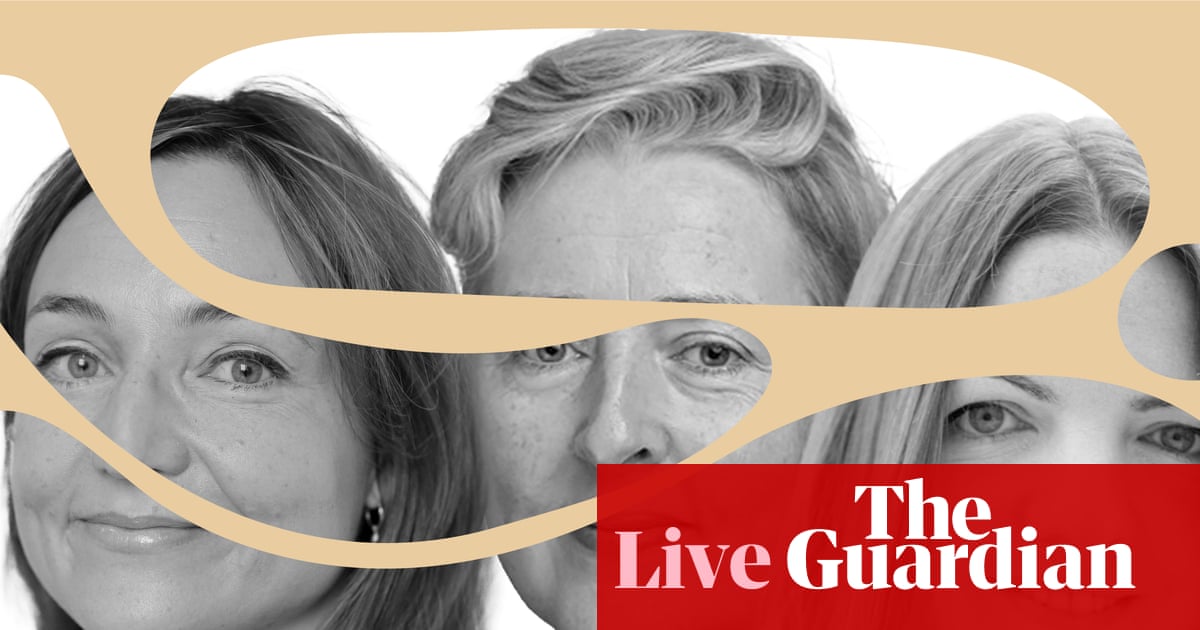
Our book experts are now live
Liese Spencer, Charlotte Northedge and Justine Jordan are answering your questions after the launch of the Booker 2026 shortlist last night.
Key events
It’s a shame Switzy and Shadow of the Object weren’t picked
Kohtao says: Can’t believe the two best books – Switzy and Shadow of the Object – were cut. Huge shame as they really added something different to the range.
Liese:
I was sad not to see Switzy on the shortlist too. I am a big fan of Emma Cline’s writing and felt that it did something really interesting. I am sure that, as always, there were plenty of arguments and some horse-trading among the judges to arrive at this list – which does still include ambitious and experimental work such as The Disappearers and one of my other faves, the brilliantly weird Black Bag.
Why no female lead characters this year?
Petherick asks: The common theme of the shortlist is men in crisis and there’s only one book with a female lead character (Marnie in The End of Everything – I don’t think the curator in May We Feed the King is gendered in the book itself and the king is the lead). Do you agree the female perspective is lacking this year and, if so, why?
Charlotte: It’s interesting that even Jarvis Cocker, one of this year’s judges, said that he found the male dominance of the list “quite surprising, because generally speaking the male-written books weren’t as good as the ones written by women”. And it’s also surprising in the light of the recent debate around the lack of contemporary novels written by men – there was even a small press, Conduit Books, established last year to focus on new male writers. So perhaps we could say that’s succeeded! But in fact, a lot of the men on the list are very long established, and there are two previous winners among them – Marlon James and Douglas Stuart.
I would say that although the perspectives are predominantly male, they’re not necessarily similar in other ways – they encompass different sexualities, and as you say, one isn’t gendered at all (funnily enough, I hadn’t read it that way, but others on the desk did and that’s obviously how it was intended). It’s interesting that we have a female author, Elizabeth Strout, writing from a male perspective, and a male author, M John Harrison, writing from a female perspective. Though Harrison’s novel isn’t entirely from Marnie’s perspective, and for me there are many other themes that jump out from these books, beyond masculinity – anxiety about the world and the future, sexuality, history, oppression. As a shortlist, it seems pretty varied to me, and I didn’t find that I missed a female perspective when I was reading these books.
Does being a poet first give a novelist an edge?
RambleCat57 asks: I adored Man in a Black Bag and I’m delighted to see it make the shortlist! Absurd and very funny. I see both poet-novelists have made the shortlist, and I’m curious about the link between poetry and literary fiction. Does being a poet first give a novelist an edge? Heightened sensitivity to language, rhythm, word choice, restraint?
Charlotte:
I really enjoyed Black Bag too, and I was really pleased to see it on the shortlist. It’s so unexpected and funny, and very thought-provoking – a real achievement. It’s great to see both Luke Kennard and Rebecca Perry on the shortlist – and perhaps not a surprise to note that there are two poets on the judging panel: Patricia Lockwood and Raymond Antrobus.
But there’s no question that poetry and novel-writing feed into one another, though the two forms require lots of very different skills as well. A poet might be able to write beautiful sentences, but sustaining that over hundreds of pages is another thing entirely. And I’m sure there are plenty of novelists who wouldn’t want anyone to read their poetry – if they’ve attempted it at all. If you can do both well enough to get shortlisted for the Booker prize, you must be doing something right!
Is the shortlist very conventional?
Petherick asks: I’ve read the whole longlist for the first time this year (thanks to my local library). Why do you think we’ve ended up with a relatively conventional shortlist when the longlist was quite left field and experimental for the Booker (thinking of The Vivisectors, Helen of Nowhere, The Renovation, The Shadow of the Object)?
Firstpoet asks: Why are the themes (in summary admittedly) so predictable? Is it that literary fiction reading and writing is increasingly coterie?
Justine: Is it relatively conventional? I’d say it’s still one-third joyfully weird – the success of The End of Everything and May We Feed the King has been one of my favourite things in 2026 so far. I was sad to see The Vivisectors go, but it did seem to me to share quite a lot of territory with Helen of Nowhere. The judges mentioned aiming for “range”’ at the shortlist event yesterday evening, which makes sense.
To Firstpoet: I wouldn’t have predicted Man in Black Leather Bag or Inexplicable Alien Artefacts this year. Inevitably, the shorthand of describing books can seem repetitive and shopworn. Toxic masculinity klaxon! Brexit! Love and loss (ie, everything)! I’d say one definition of a good book is that it can’t be summed up, it has to be read in full, and then we get back to issues of time and space.
How does genre affect judgements?
UninventiveName asks: How possible is it to separate personal thematic or genre preferences from your appreciation of the quality of a novel? Is it even desirable to attempt to do so? I listened to an interview with a judge a couple of years ago who clearly felt the inclusion of an out-and-out science-fiction novel on the longlist was rather outre.
Liese: I think every reader is going to have personal thematic and genre preferences, and that is no different for Booker judges. Having said that, some of my most thrilling reading has happened when I’ve been surprised by a book from a genre I might not generally have been drawn towards – or when I’ve discovered a novel that mixes genres in a really interesting way. So I guess that I think it’s impossible to separate your preferences from your appreciation of a novel – but such preferences might also bring depth and range to the way that the Booker judges make their selection … So, for example, in 2018 when Val McDermid was a judge she championed Belinda Bauer’s thriller Snap – which may not have made the cut another year. The same year, Nick Drnaso’s Sabrina was the first graphic novel to be Booker listed – which may have been the influence of her fellow judge Leanne Shapton, who is herself a graphic novelist, artist and author.
Ultimately perhaps the distinction to be made is between popular, commercial fiction and literary fiction (see Martin MacInnes’s longlisting for his very literary sf novel In Ascension in 2023). But maybe that’s just a whole other can of worms! See the question on how to define literary fiction…
What is literary fiction, really?
UninventiveName asks: What is literary fiction, really? Seems a meaningless term to me.
Charlotte: That’s a good question, and one that we discuss on the books desk all the time – we’re often trying to fit new novels into neat categories in our books coverage, when in fact you can have a novel that is, for example, sci-fi, dystopian and literary all in one – M John Harrison’s The End of Everything is a good example of that. That’s a novel that could have appeared in our monthly science fiction and fantasy roundup, but got a standalone review instead, because it was so clearly a book that merited a longer review, and one that people on the desk were excited about. And we’ve been vindicated, because here it is on the shortlist!
To me, literary fiction really means any novel that has ambitions beyond fitting into a particular genre category. Many novelists write brilliant romantic fiction, or sci-fi, or fantasy and sell lots of copies, and win prizes within those categories. And lots of those books are also literary. But literary fiction in its broadest sense means novels that transcend genre. I’d be interested to know what others think though. Obviously it’s a tricky one to pin down.
Do we need a single winner at all?
Alex42 asks: Do we need a single winner at all? Once you’re down to the shortlist – or even possibly the longlist – you’ve hopefully already got a collection of excellent books to cover a range of tastes. What do we really achieve by picking one of them out? This could apply to any award really, but the idea of ranking works of art in any medium always strikes me as quite odd.
Liese: I agree that – looked at one way – ranking works of art is obviously ridiculous. (We had the same conversation around our 100 greatest novels of all time. Given how subjective reading is, there’s something silly about saying that White Teeth is better than A Farewell to Arms or The Prime of Miss Jean Brodie beats David Copperfield). But I would say that the point of that exercise and of the Booker prize too is to spark a conversation and draw attention to great literature. For that reason, I’d argue that it is well worth doing. And from my point of view, there absolutely has to be a winner because otherwise the whole exercise is a bit pointless – and it gives one author a huge boost to their career.
When the judges refused to follow the rules and insisted the prize be split between Bernardine Evaristo and Margaret Atwood in 2019 I think the general consensus was that rather than sharing the glory it detracted from both of their achievements (Atwood said afterwards “I kinda don’t need the attention”).
How do you read 163 novels in 180 days?
senoj1 asks: To get down to the shortlist, how do the judges manage to read 163 novels in 180 days, and then make time to discuss their relative merits and whether a book should move forward or be dropped? It’s nearly a novel a day every day for 6 months, all done alongside jobs, family duties, and all of life’s other demands. Are the rest of us just mere amateurs?
Willduff says: I wonder if this explains why such very slight – in every sense – novels like Orbital and Flesh won the past couple of years. The shortlist looks interesting, though.
Justine: It’s a crazy job, but someone’s got to do it – and you only have to do it once. When I was on the judging panel in 2024, the year Orbital won, I took a sabbatical from work which helped and just made reading my number one priority for nine months – what a privilege! My day job is looking at novels and deciding what we should review and who we should send the book to so – uniquely – all that reading is what I feel I should really be doing every year anyway. What readers have in common is that the TBR pile never diminishes.
Undeniably, Booker judging is a strange way to read – at great speed, and then repeatedly, up to three times at least for the shortlist – but it does mean you’re considering novels in the round, in a snapshot of the publishing year, in a really interesting and fertile way. I’ve been on judging panels where the books are shared out, so not everybody reads everything, and the Booker USP is definitely the fact that there are five minds directed on every submission.
To Willduff: I’d disagree here, though I would, wouldn’t I – Orbital is a Tardis of a book, a lot bigger on the inside. Flesh seemed a strong winner to me, too, it’s a novel so utterly committed to its own project (with perhaps a tiny whiff of sentimentality towards the end). Though my favourite of last year’s Booker books will always be Andrew Miller’s The Land in Winter.
Our book experts are now live
Liese Spencer, Charlotte Northedge and Justine Jordan are answering your questions after the launch of the Booker 2026 shortlist last night.
Welcome to the conversation
For today’s reader Q&A we’ll be discussing the newly announced shortlist for the 2026 Booker prize which was revealed last night at a discussion at London’s Southbank centre featuring this year’s judging panel: Jarvis Cocker, Mary Beard, Patricia Lockwood, Raymond Antrobus and the Guardian’s own Rebecca Liu.
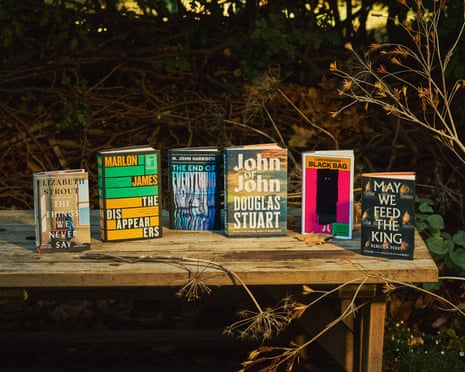
The panel’s final six selections for 2026 are:
The End of Everything by M John Harrison (Serpent’s Tail)
The Disappearers by Marlon James (Hamish Hamilton)
Black Bag by Luke Kennard (John Murray)
May We Feed the King by Rebecca Perry (Granta)
The Things We Never Say by Elizabeth Strout (Viking)
John of John by Douglas Stuart (Picador)
The winner will be announced on 9 November 2026 at a ceremony at Old Billingsgate in London.
Liese Spencer and Charlotte Northedge are the Guardian’s joint head of books. Justine Jordan is the Guardian’s fiction editor and was a Booker judge in 2024, a task for which she had to read 150 books in a row (her top tip for doing so was: “put your phone in a different room”).
Discuss the shortlist below and/or post a question for Liese, Charlotte and Justine.
Sign in or sign up now to join the conversation.
#Booker #prize #Guardians #book #team #live #answering #questions #Books