wellnessfitpro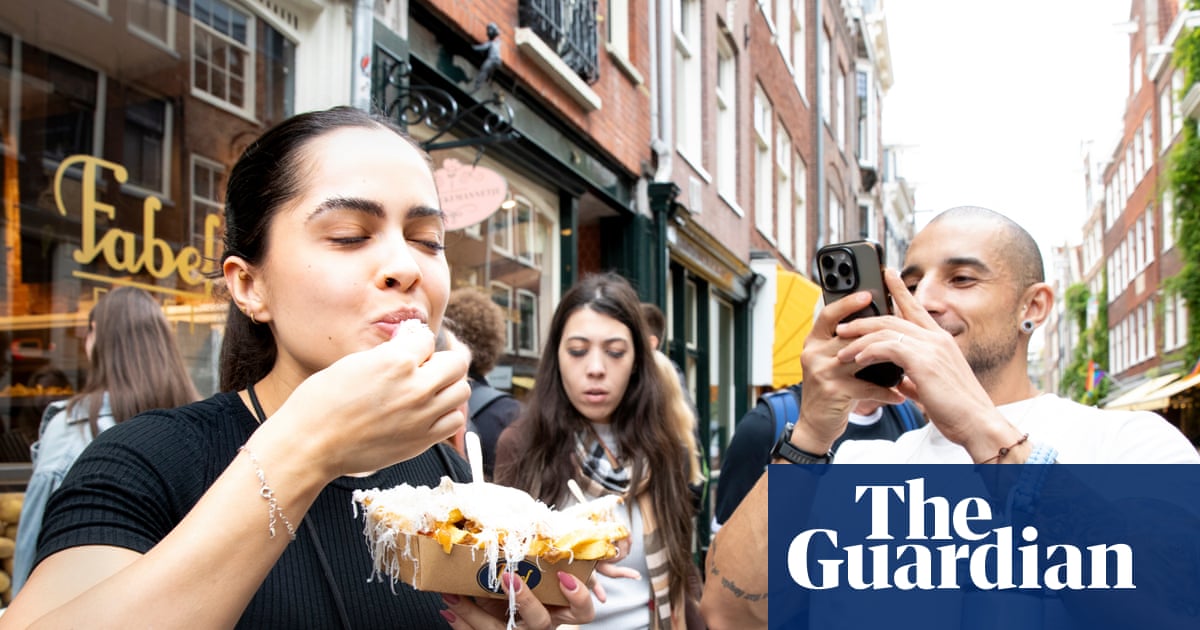
People living in one of Amsterdam’s most exclusive neighbourhoods have taken the city to court for licensing a chip shop that has gone viral on TikTok.
On busy days, the queue for Fabel Friet on Runstraat stretches across a bridge on the Keizersgracht – one of Amsterdam’s three main canals – a court was told last week. The narrow street itself is crowded by tourists waiting for their orders seven days a week. And loitering with intent – on parked cars, on the street itself, and on steps and porches – gulls wait to swoop.
“We are in a kind of war where a very unwelcome chip shop has polluted the whole area,” said Thomas van Leeuwen, who lives nearby. “Eating in the street is a shameful behaviour. It gets filthy food on our doorsteps and mayonnaise in the beautiful stone. The herring gulls have moved in as residents, and the worst thing is the rat infestation.”
Nineteen neighbours have formally protested against the business licence for Fabel Friet, whose signature product is fries topped with parmesan cheese and truffle mayonnaise. Niek van der Heijden, the lead plaintiff, said the problem was the takeaway’s small size.
“What we call the ‘TikTok queue’ for Fabel Friet causes the most nuisance,” he said. “The business takes place on the street: waiting to order, waiting to be served, eating. We want Fabel to go to a place where there is enough room to have clients inside.”
In a packed courtroom on Tuesday morning, a lawyer for Amsterdam city council acknowledged that the city’s mayor, Femke Halsema, can refuse a licence to operate if the “residential and living environment” is negatively affected by a business.
While the chip shop, she said, sticks to its licence obligations to manage the queue and clear litter “it has been going on for a long time, the impact remains severe, and you have to ask: how long can we tolerate this?” For the current licence, she said, the city would be guided by the court’s ruling.
The shop’s owners, Abel Klatser and Floris Feilzer, said they employed a cleaning service seven days a week, four times a day, and that year-on-year visitor numbers had dropped by 23% this August after they opened four new locations. “A few neighbours have experienced nuisance, but other people enjoy eating chips,” said Gertjan Teeuwen, their lawyer. “It can be busy, but there are peaks and troughs.”
Klatser and Feilzer said in a public statement that they felt unfairly attacked while doing their best to be good neighbours. “Fabel Friet is our child, and we have put our heart and soul into it,” they said. “It is painful if people talk about our business negatively.”
The case goes beyond irritations about so-called performative tourism, where tourists flock to a place to post images on social media. “The tiny streets might be charming, but actually the space is not designed for so many people,” said Lisa-Bobbie Kamp, a lawyer for the neighbours. “This is a question of taking space, who owns the place and whether you can just use public space.”
Marije Peute, a PhD student at the University of Amsterdam, has studied the effects of “viral urbanism” in the neighbourhood. “The municipality should really think about how they want to act, because this is about the public space. A lot of much older retail spaces have lost their local clients because they don’t want to go there any more,” she said.
Rogier Havelaar, a councillor from the Christian Democratic Appeal party, said that, while Fabel Friet should probably be offered a “flagship store” licence in a more suitable location, the benefits of tourism to the city should not be overlooked. “Amsterdam would never have as many museums, restaurants, going-out spots and theatres if they were only for the residents,” he said. “And tourism provides 70,000 jobs. Amsterdam would have a gigantic financial problem if tourism went away.”
Standing on the bridge over the Keizersgracht, some German laboratory apprentices drawn by TikTok were enjoying their chips. Natalie Stübben said crowd managers had just asked them to move away from people’s houses. “It’s pretty hard to get through here with a car or just by walking,” she said. “I don’t think we were thinking about annoying the neighbours, but it makes sense.”
Some of those neighbours will be pleased if the business location has had its chips after the court verdict on 12 November. “There’s something very alarming about the fact that these people are all led by their higher power – influencers – and call themselves followers,” said van Leeuwen. “It’s Orwellian. This court case is part of the parasitic industry that lives on tourists.”
#kind #war #row #viral #Amsterdam #chip #shop #lands #court #TikTok