wellnessfitpro
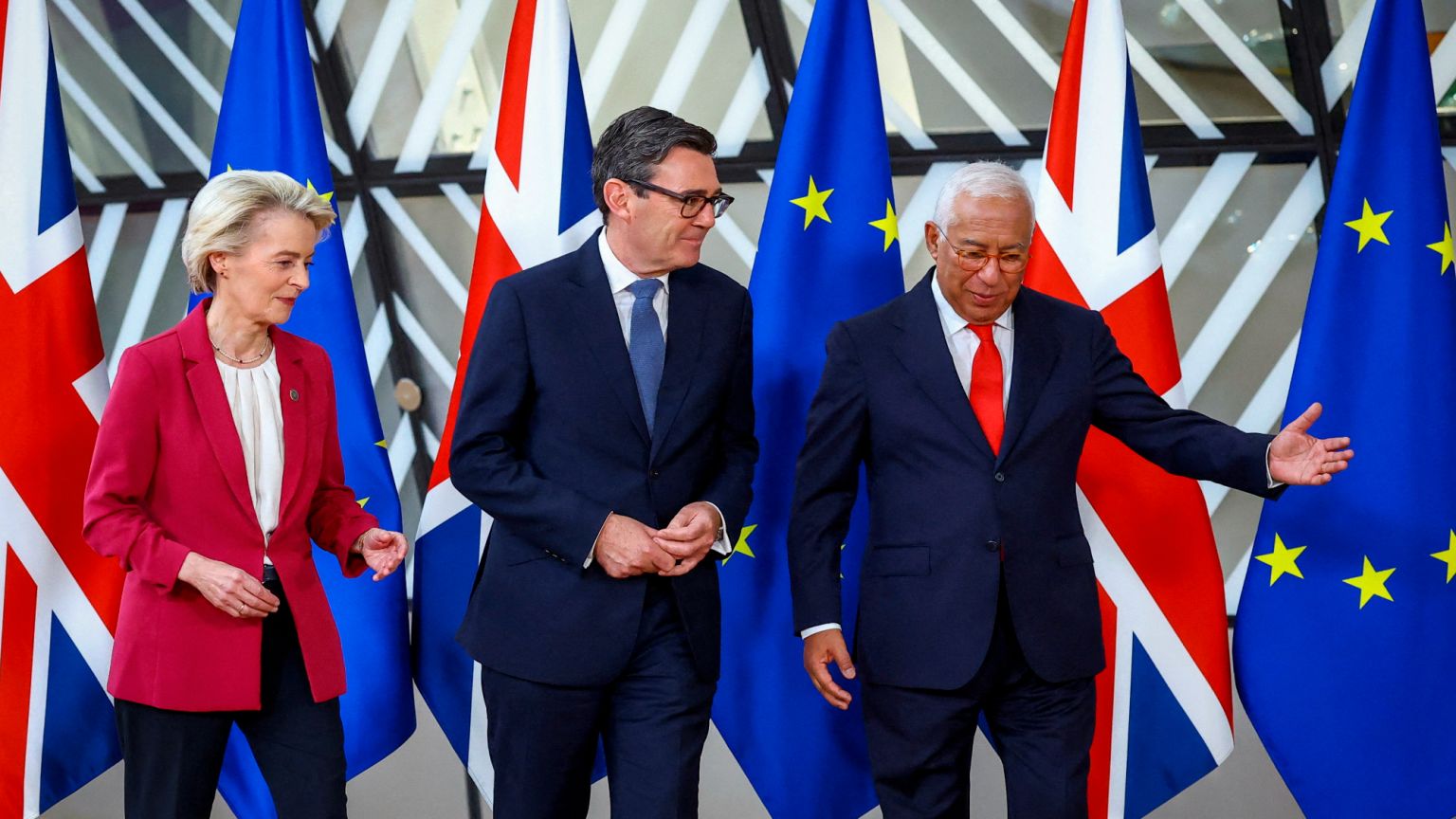
Andy Burnham has promised a ‘national conversation’ on Britain’s relationship with the European Union. Having unveiled his ‘Brexit reset’ deal in Brussels last week, subjecting the UK to EU rules on agrifoods and more, the PM has let it be known that he wants the UK to rejoin as a full member. So, what exactly would Britain be rejoining? And does the EU really live up to Burnham’s expectations?
According to Burnham, getting closer to the EU will give ‘bigger horizons’ to British young people and address youth unemployment. Yet this is the same EU that is currently suffering from a youth-unemployment crisis. In Spain, France, Sweden and Finland, more than one in five young people looking for work cannot find it. France’s youth-unemployment rate of 22 per cent is far higher than Britain’s at 15 per cent. In Italy, fewer than half of people in their twenties have a job at all. Across much of southern Europe, there is a generation of people still living with their parents at 30. Is this the future Burnham wants for Britain?
Most Brits have a vague sense that things on the continent are not going well. The most obvious sign has been the enormous outbreak of violence and looting in France. More than 6,500 people, most of them minors, were arrested in the first few weeks of unrest alone. But the problems in the EU run much deeper than the French riots. In the decade since the Brexit referendum, the EU has become less democratic, more hostile to free speech and steadily poorer.
Britain voted to leave in large part because the electorate had long felt that power was ebbing away to Brussels. The EU was experienced both as a source of endless undemocratic diktats and as a hiding place for an idea-less political class desperate to avoid accountability from the electorate. These anti-democratic tendencies within the EU have only intensified since 2016. European elites have increasingly resorted to non-democratic instruments to force through their agenda. They have exploited treaty provisions written for emergencies to legislate without any input from voters. Such chicanery underpinned SAFE, a €150 billion defence-loan scheme, adopted without MEPs having a say. Little wonder that René Repasi, the legal-affairs coordinator of the European Parliament’s Socialists and Democrats group, accused European Commission president Ursula von der Leyen of ‘a clear strategy of consolidating power within the EU executive’. He’s not wrong.
Democracy within the EU is in a bad way. Elections in EU member states have become negotiable. Romania annulled the result of its presidential election in 2024, after the ‘wrong’ candidate won. In Poland, the government recently ordered the police to storm and take over the constitutional court. In France and Germany, the authorities are pursuing the main opposition parties through endless lawfare. And the EU has either watched all this behaviour with indifference or actively encouraged it. As for the leadership in Brussels itself, no election can remove the permanent bureaucracy that runs member states’ affairs.
Brussels also has free speech in its sights. Introduced in 2022, the Digital Services Act empowers content-monitoring organisations, referred to as ‘trusted flaggers’, to press platforms to remove or bury content they deem potentially illegal. Fines for non-compliance can be up to six per cent of a platform’s global turnover. Last December, the EU fined X (formerly Twitter) €120million, largely because it attempts to offer users greater freedom of speech than its rivals.
On top of this sits the European Democracy Shield, unveiled last year. It features a network of ‘independent’ fact-checkers and advocates ‘pre-bunking’, which means warning citizens off certain arguments before they have even heard them.
What this looks like in practice became clear in July, after approximately 70,000 people crossed into Ceuta, a Spanish enclave in north Africa. An investigation by FSI Europe, where I am policy director, found that Newtral, the Spanish fact-checking organisation, sent its head of verification to three meetings on the Ceuta crisis, including a roundtable discussion in Brussels featuring around 20 representatives of EU institutions, platforms and fact-checkers. By its own account, Newtral then flagged more than 70 pieces of content through the rapid-response system of the EU’s Code of Conduct on Disinformation. It wasn’t just fake content that was flagged for removal, but also posts containing ‘misleading’ political arguments – ie, arguments that challenged the EU and Spanish government’s immigration policies.
Worryingly, Burnham already seems to be learning from the EU’s attempt to regulate political debate in the name of combatting ‘misinformation’ and ‘Russian interference’. Working hand in glove with the intelligence agencies, the police and social-media companies, Burnham’s National Centre for Information Defence aspires to ‘detect, attribute and disrupt’ so-called hostile information attacks. This initiative, launched in September, is squarely modelled on the EU’s Democracy Shield. In both cases, the real aim is clearly to create a shield against democracy and free speech online.
Meanwhile, economic growth – supposedly the main rationale for European integration – is stalling across the continent. The EU’s addiction to green mandates, carbon taxes, and endless regulation is a major driver of this. The German economy, once the engine of Europe, shrank in 2023 and 2024 before growing by just 0.2 per cent in 2025. It is estimated that German industry cut around 124,000 jobs last year, with 50,000 of them in car-making. Since the June 2016 Brexit referendum, Britain’s economy has grown by 14.7 per cent, against 12.6 per cent for France and 8.0 per cent for Germany.
Europe’s energy policies have a lot to answer for here. European firms pay two to three times as much for electricity as their American competitors – and the disparity is only growing. Brussels has responded with a raft of measures almost guaranteed to make the problem worse. From 2028, a new, more expensive carbon-pricing regime, ETS2, will land on petrol, diesel and home heating across the EU. This was meant to be implemented in 2027 but was pushed back a year for fear of the impact on household bills. With fuel prices rising again, thanks to the war in Iran, several governments want ETS2 delayed further. Whether it is delayed or not, the very fact that the EU should even propose hiking energy costs shows how warped its priorities are.
Then there are Europe’s sky-high debt levels. France expects public debt to reach 119.3 per cent of GDP by the end of this year. There are fears that France could face a Greek-style economic meltdown. The EU’s draft budget would allow the European Commission to borrow up to €350 billion for crisis loans to member states, backed by national treasuries. But this attempt to increase the EU’s budget is running up against opposition from member states that have little cash of their own to spare.
No wonder that many in the EU are rubbing their hands at the prospect of Britain getting close to the EU. ‘Burnham needs Europe and we need cash’, one EU diplomat is reported to have said recently. If Britain were to rejoin as a full member, the financial demands would only become more onerous. One pro-Brexit campaign group put the cost to Britain at £750million per week. Whatever the final sum, the financial burden of EU membership would hit households very hard.
Andy Burnham’s pitch for rejoining ignores how much has changed in Brussels in the past decade. The European Union of 2026 is even more eager to sideline voters and more aggressive in policing what they say than the European Union of 2016 – and it even charges more for the privilege of membership. This is not a club that we should want to be a part of.
Jacob Reynolds is policy director at Freedom and Sovereignty Initiative Europe. Follow him on X: @jacobreynolds.
#Todays #worse #voted #leave