wellnessfitpro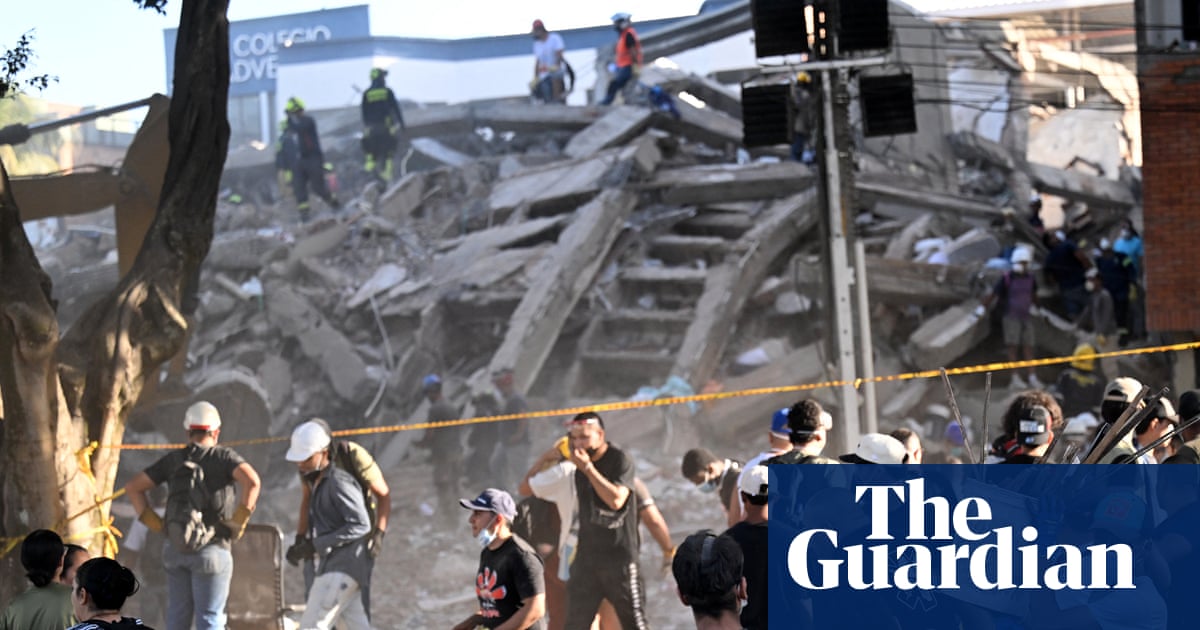
Colombian rescue workers are racing to find survivors after the country’s deadliest earthquake this century killed at least 224 people and left at least 3,000 missing.
In Cali, one of the worst affected cities, firefighters said they had pulled a 35-year-old man from the wreckage of a collapsed building shortly before 4am on Tuesday – nearly 24 hours after the 7.4 magnitude quake rattled western Colombia.
“We have found life under the debris … Every minute counts,” the fire department wrote on X alongside a video of a survivor being rescued from beneath a concrete beam.
Civilians reportedly pulled at least five survivors from a partly collapsed hotel, although elsewhere the bodies of some of the city’s 85 confirmed victims could be seen lying on the street under sheets.
Colombia’s president, Abelardo de la Espriella, was sworn into power in Cali only last Friday. On Monday night he was back in his country’s third-largest city, telling reporters that 5,000 homes had been destroyed and 188 people were missing in the surrounding department of Valle del Cauca.
“We will get through this together,” Cali’s mayor, Alejandro Eder, told its 2.3 million citizens during a televised meeting with the new president.
Eder said emergency responders had rescued 37 people from some of the 40 buildings that had completely collapsed in Cali. De la Espriella, who won power in June by vowing to launch a major crackdown on illegal armed groups, said more than 1,000 troops were being mobilised to avoid public disturbances amid reports of looting.
The situation in Pereira, a city 130 miles to Cali’s north, appears similarly dramatic, with at least 53 people reportedly trapped in some of the 58 buildings that collapsed. Eleven people are missing, according to the local newspaper El Diario.
On Monday, Pereira’s mayor, Mauricio Salazar, broke down in tears as he described the damage inflicted on his city, where at least 66 deaths have been confirmed.
“Pereira is living through a historic and tough situation,” Salazar told reporters, his voice breaking as he explained how local hospitals were struggling to keep up with the influx of patients.
The earthquake, which struck at 7.34am on Monday, is Colombia’s deadliest since a 6.2 magnitude temblor devastated parts of the same western coffee growing region in January 1999, killing more than 1,000 people.
The natural disaster poses an immediate and severe challenge to De la Espriella, a far-right populist with no experience of politics or governing who took office less than 72 hours before the earthquake.
The acting leaders of neighbouring Venezuela were castigated by civilians for what many considered their lethargic and incompetent initial response to the twin earthquakes that struck its north coast on 24 June, killing at least 6,300 people.
In the crucial 72 “golden hours” after Venezuela’s earthquakes, survivors said government officials and troops were nowhere to be seen, something widely attributed to years of economic crisis, corruption and the mismanagement of the armed forces, as well as foreign sanctions.
Colombia’s earthquake on Monday appears to have caused substantially less damage than Venezuela’s far shallower and more destructive earthquakes. But the official reaction – at least so far – appears to have been far more organised, proactive and transparent than in Venezuela, where civilians were often left to their own devices to dig victims from the rubble.
In the hours after Colombia’s earthquake, De la Espriella quickly declared a state of emergency and said he would personally lead the disaster response, making a trip to the department of Chocó, before travelling to Cali. He has sent teams led by various ministers in his recently named cabinet to each of the worst affected places. Government officials have offered regular updates on the situation. De la Espriella is due to fly to Pereira on Tuesday.
Experts attribute the two countries’ contrasting responses to their starkly different political realities.
Venezuela has suffered more than a decade of authoritarian rule under the recently abducted dictator Nicolás Maduro, during which time the country’s institutions, media and civil society withered and international aid groups and NGOs struggled to operate.
Critics have voiced fears over a possible authoritarian tack under Colombia’s recently installed pro-Donald Trump leader. But the country remains a vibrant multiparty democracy with strong institutions and an energetic civil society.
Christopher Sabatini, a senior fellow for Latin America at Chatham House, believed those very different systems explained the dramatically different responses to the natural disasters.
Sabatini recalled how after June’s twin earthquakes, Maduro’s secretive authoritarian heirs – who have retained power with Trump’s blessing under acting president Delcy Rodríguez – had gone into “a defensive crouch” as citizens were abandoned to their own fate. “They just went quiet,” in the hours after the disaster, he said.
In contrast, Sabatini sensed in Colombia “a quick, sharp, public-facing and immediate response” from officials such as Cali’s technocratic mayor, and even the controversial new right-wing president, in what was “an efficient, effective state”.
“It shows the democratic DNA of both sides,” Sabatini said of the contrasting earthquake reactions in Colombia and Venezuela.
Orlando Pérez, a Latin American politics expert from the University of North Texas at Dallas, also noted major differences in the responses, although he recognised that Venezuela’s disaster was more severe.
“Everybody is praising de la Espriella’s quick response – and I’m willing to give him his due. He has reacted in a much more public way and shown leadership in an overt manner. The Colombian military has been deployed in a much more effective and quick [manner] than in Venezuela,” said Pérez, noting how conservative social media influencers were explicitly pushing the comparison between Rodríguez’s sluggish response and the seemingly rapid reaction of her Colombian counterpart.
“But things could go south pretty quickly if the initial burst of energy and activity is not followed up with effective reconstruction and recovery and assistance for the … people who have lost their homes and their jobs,” Pérez added.
“We have seen in other places where initial responses are positive and then recovery doesn’t come quickly enough, and people get frustrated.”
#minute #counts #rescuers #race #find #survivors #deadly #Colombia #earthquake #Colombia