ProPublica is a nonprofit newsroom that investigates abuses of power. Sign up to receive our biggest stories as soon as they’re published.
American children lined up for the world’s first measles shots in the early 1960s, but it took nearly 40 years of shoring up immunization programs before the infamous contagion had been so thoroughly controlled that a panel of experts declared in 2000 that the United States had eliminated measles within its borders.
For a quarter century, the U.S. only saw outbreaks when infected travelers brought the virus in from abroad. The resulting waves of measles didn’t last more than a year.
Those days are gone.
Measles began tearing through the dusty plains of West Texas in January last year, and since then, all but a handful of states have seen cases. Two unvaccinated Texas girls and an adult across the border in New Mexico died before the West Texas outbreak seemed to burn out last July.
By then, measles was popping up in Utah, and state health officials couldn’t tell where the earliest patients had caught the virus. Infections in that state took off that fall and winter and continued into May of this year.
The Texas and Utah cases now sit at the center of an unusually technical — and politically fraught — question: whether the United States will lose its measles-free distinction.
Countries aren’t penalized for losing the status, but it’s an indication of cracks in a nation’s once rock-solid immunization programs, a loss of faith in vaccines among its people — or both.
To have any chance of keeping the designation, the U.S. will need to make a strong case that measles didn’t spread endemically — from person to person in a continuous chain within the country for more than a year. If the Texas virus, for example, made its way across the Southwest to Utah and continued infecting people there, that would be a problem. But if cases in Utah were instead sparked by a patient who caught measles abroad, that would be a new chain, restarting the clock.
For clues, the Centers for Disease Control and Prevention is analyzing the full genetic code of measles viruses that infected patients. Last November, the CDC’s leader at the time said preliminary genomic analysis suggested the Utah cases were not directly linked to those in Texas. A spokesperson for the Department of Health and Human Services told ProPublica that the work was done by the state laboratories and the CDC is conducting a more comprehensive investigation.
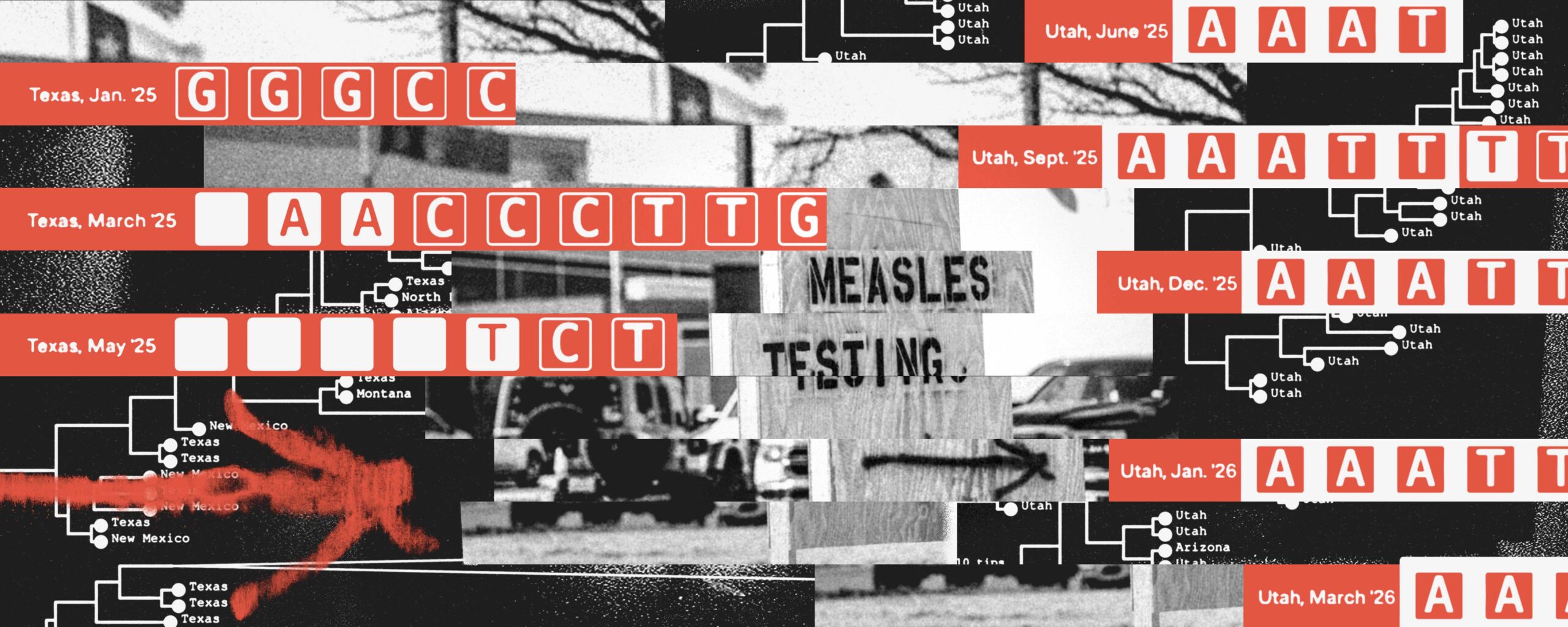
ProPublica embarked on its own analysis, reviewing over 1,800 whole genome sequences, including those released as recently as last month, to compare the genetic fingerprints of measles viruses circulating in the U.S. and Canada. This showed that the measles virus still spreading in Utah as of this May is very closely related to the one that sickened Texans over a year ago.
ProPublica’s analysis isn’t a smoking gun that proves endemic spread. It’s impossible to tell from this information whether the virus spread from state to state or if it at some point left the country and was brought back by a sick traveler.
But given how similar the viruses are in the sequences ProPublica identified, it’s going to be difficult for the U.S. to prove measles isn’t endemic — “unless CDC has something up their sleeves,” said Dr. Alberto Severini, a retired molecular virologist and measles expert who spent two decades at Canada’s Public Health Agency.
The unique fingerprint of mutations hasn’t been limited to these states. The five mutations observed in Texas and Utah were also present in sequences the CDC published of viruses that infected patients last May and June in Iowa, North Dakota, Minnesota and Alaska.
But it’s not clear that the genetic fingerprint is only in the U.S.: No whole genome sequencing has been made public from cases in either Mexico or the Canadian province of Ontario, where measles has also raged.
That matters because whether the virus was spreading continuously in the United States for more than a year — rather than circulating abroad and being brought back into the country by travelers — is a key question facing a panel of experts convened by the Pan American Health Organization.
A regional office of the World Health Organization, PAHO will decide whether the U.S. keeps its measles-free designation. Canada lost its status last year. PAHO invited the U.S. to make its case in April, but American officials asked for more time to investigate how the virus had been spreading. The review was moved to November.
Daniel Salas, a PAHO official, said the kind of thorough analysis that CDC is doing “takes time.”
“What the U.S. is trying to do with this whole genome sequencing is trying to find some patterns that could eventually say, for example, this mutation of the virus occurred in a different country, in a different place to the current outbreak that they’re trying to analyze, so that eventually, that might be taken into consideration to somehow replace the epidemiological information that is missing,” he said. “There’s no country that has done this before.”
One of the biggest questions is how the virus got into Utah. Health officials determined that the first confirmed patient there, identified last June, couldn’t have been exposed to measles in another country or even another state. Utah State Epidemiologist Dr. Leisha Nolen said she and her team reviewed the places the patient had been and the people they had been around, but still couldn’t figure out where they caught the virus.
Clues suggested measles had been quietly spreading in the region. A CDC disease detective investigating subsequent cases that spanned the Utah-Arizona border said there had been reports of community members with rashes last June, but the patients declined measles testing and families were often reluctant to answer questions.
Throughout the outbreak, no interviews suggested any patient was exposed in another country, Nolen said, but she and her team cannot rule out the possibility.
ProPublica asked the CDC whether its epidemiologists had linked any of Utah’s measles cases to an international outbreak, but the agency wouldn’t say, nor would it directly comment on genetic similarities ProPublica found between viruses in Texas and Utah. In a written statement, a spokesperson said, “Sequencing alone cannot determine whether transmission has been continuous or sustained.”
While genomic analysis can provide clues, the spokesperson wrote, “These findings must be interpreted alongside epidemiological data, including travel history, exposure information, and known outbreak connections.”
The CDC is still working on “a comprehensive analysis of potential linkages among cases and outbreaks” and has gathered additional epidemiological data, the spokesperson said, but did not elaborate on what that shows.
With the midterm elections approaching, the spread of measles has become a political liability for President Donald Trump, who picked the founder of an antivaccine organization to be his health secretary. Since Trump’s inauguration last year, there have been more than 4,300 U.S. cases, a high not seen in three decades.
Eliminating the endemic spread of measles is the public health equivalent of slaying a dragon. The disease is among the most contagious humans have ever encountered. Patients are infectious even before the telltale rash appears, and the contagion can linger in a room for two hours after they leave.
Policymakers built the U.S. immunization system on lessons learned from measles outbreaks. To get the sky high-vaccination rates needed to stop the disease from spreading, states made shots mandatory for school and daycare attendance, and the federal government provided them free to low-income kids. When measles still managed to roar back, state lawmakers in California and New York cracked down on exemptions to their school mandates. The U.S. helped other countries fight measles, too, not only to prevent deaths but also because people in power recognized that infectious diseases kept in check abroad are less likely to return to American shores.
During prior U.S. outbreaks, health and political leaders, with unwavering language, urged Americans to vaccinate their children and assured them the shots were safe.
Trump and HHS Secretary Robert F. Kennedy Jr. haven’t followed that playbook. Both have fueled doubts about the safety of the MMR shot, which guards against measles, mumps and rubella.
Researchers around the world have found the vaccine does not cause autism. Nevertheless, at a press conference on autism last fall, Trump said he had heard for years that there was a problem with the combination vaccine and urged parents to insist on separate shots for their kids — even though standalone shots don’t exist in the U.S.
Kennedy has said the vaccine offers protection from measles, but he also has repeatedly made the shot sound scarier than the disease.
“There are adverse events from the vaccine,” he told Sean Hannity on Fox News last year. “It does cause deaths every year.”
On a podcast, Kennedy said that when he got the virus as a kid, he got to watch television for a week. “I got chicken soup and vitamin A, which nobody can patent,” he said.
Measles kills 1 to 3 out of every 1,000 people infected and can cause deafness, intellectual disability and brain swelling. In a “know the facts” post, the Infectious Diseases Society of America said there have been no deaths shown to be related to the shot in healthy people. “There have been rare cases of deaths from vaccine side effects among children who are immune compromised, which is why it is recommended that they don’t get the vaccine,” the medical society explained. “That’s why it is so important that everyone who can get vaccinated does so, to protect those who can’t.”
HHS spokesperson Andrew Nixon said in an email that Kennedy “believes Americans deserve clear information about both the benefits and risks of medical products so they can make informed healthcare decisions in consultation with their healthcare providers.”
Nixon said “heavy-handed mandates” contributed to the significant loss of trust in health institutions during the COVID-19 pandemic. “The Secretary maintains that public health agencies rebuild trust through honesty, transparency, and respect for individual choice — not coercion,” Nixon wrote.
Kennedy has tried to distance himself and the administration from the measles resurgence. He said the U.S. has done a better job of limiting the spread than any other country and pointed to the far higher number of cases in Canada and Mexico, whose populations are much smaller.
White House spokesperson Kush Desai told ProPublica, “Fake News reporters should be spending more time examining why the Trump administration’s efforts to contain America’s measles outbreak has been so much more successful than those of Canada and Mexico instead of regurgitating the same, tired narratives.”
Kennedy has also reminded lawmakers that the Texas outbreak began before he became health secretary.
“We have a global pandemic,” he told senators in April. “It has nothing to do with me.”
Kennedy has been among the most prominent voices in the antivaccine movement for more than a decade.
Dr. Adam Ratner, a pediatric infectious disease physician who wrote a book about measles, said Kennedy has done “everything in his power to undermine confidence in vaccines in the U.S.”
During a measles outbreak in New York City that began in 2018, Ratner treated at least five unvaccinated kids who were hospitalized, including a couple who needed intensive care, so he knows that not every child escapes the disease with nothing more than memories of screen time and soup.
While most parents still support immunizations, Ratner worries that the country no longer has the stomach for the kinds of policies that once stopped endemic spread. Rather than making school vaccine requirements stricter, some states are working to do away with them altogether in the name of medical freedom.
“You need a highly vaccinated population to control the spread,” he said. “In the absence of that, I think that we will have ongoing spread, and we’ll have tragedies like the ones that we saw in West Texas with the two kids who died.”
The U.S. may very well find the international travelers it needs to prove that the country is still measles free. But if all remains the same, experts said, it will only be delaying the inevitable.
“It doesn’t change the fact that there’s been transmission of measles in the United States for over a year,” Severini said. “If people don’t vaccinate, measles is going to be endemic.”

Related Posts
wellnessfitpro
- border
- construction
- October 10, 2026
- 0 Comments
DHS Border Wall Construction Leads to Surveillance of Tohono O’odham Nation — ProPublica
Reporting Highlights Promising Cooperation: The Tohono O’odham Nation sued to stop a wall from being built on their land. In court, DHS gave assurances that the government would engage with…

- DraftKings
- Experiment
- October 10, 2026
- 0 Comments
Inside Our DraftKings Gambling Experiment — ProPublica
Earlier this year, we heard that reporter Jake Pearson planned to ask our editors at ProPublica for more than $20,000 so he could spend the NBA playoffs betting like a…