wellnessfitpro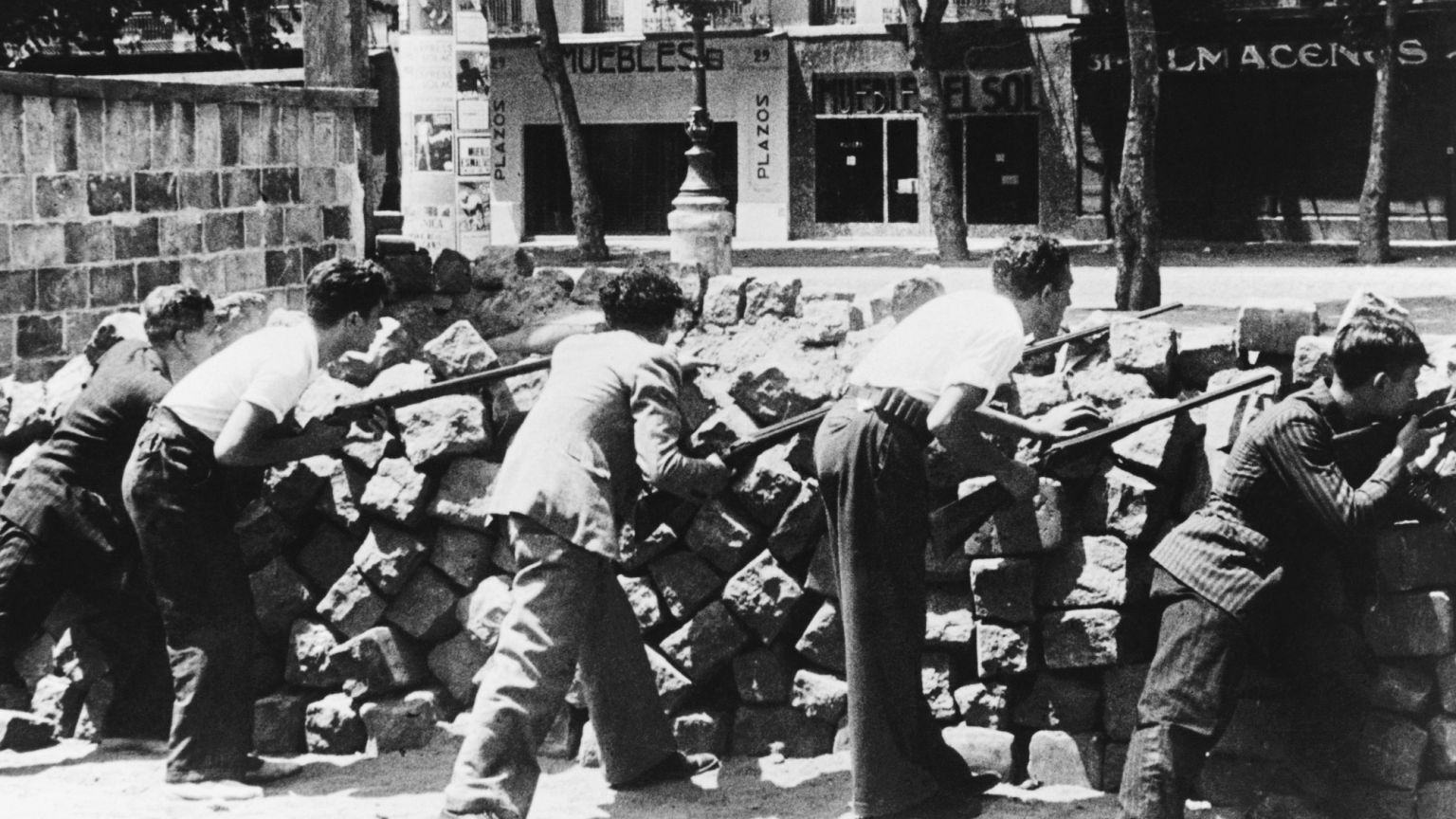
The Spanish Civil War began 90 years ago. On 18 July 1936, General Francisco Franco, alongside fellow general Emilio Mola, led a right-wing military revolt against the democratically elected Popular Front government of the Second Spanish Republic.
In the context of the rise of fascism in Italy and Germany, the outcome of the Spanish Civil War was viewed as crucial to Europe’s future. Franco received military support from both Italy and Germany, while the beleaguered Spanish Republic benefited from the support of the Soviet Union, including through arms and thousands of foreign fighters. In all, around 35,000 volunteers from 53 countries joined the Communist Party-led International Brigades.
George Orwell arrived in Spain in December 1936. He was prevented from joining the International Brigades, and instead joined up with a militia organised by the Workers’ Party of Marxist Unification (POUM).
It was a decision that would change the course of his thinking and creative output. He travelled to Spain as an ardent anti-fascist and returned as a determined anti-Communist, or more precisely, an anti-Stalinist. The shift in worldview, prompted by his experiences during the Spanish Civil War, produced not only the memoir, Homage to Catalonia, but also Animal Farm and Nineteen Eighty-Four – two novels that to this day warn us about the threats to freedom of thought and speech.
Orwell initially intended to join the International Brigades. He approached Harry Pollitt, the general secretary of the Communist Party of Great Britain, with letters of introduction in hand. But Pollitt didn’t take to Orwell, partly because of his rather upper-class, Old Etonian background and partly because of his work in Burma for Britain’s colonial administration. Deeming Orwell ‘politically unreliable’, Pollitt rejected him. He had no idea how ‘politically unreliable’ Orwell would turn out to be.
After failing to gain a berth in the International Brigades, Orwell contacted his associates in Britain’s socialist Independent Labour Party (ILP). The ILP had offices in Barcelona to which its volunteers reported. He was then directed to the offices of the anti-Stalinist POUM, the Spanish sister organisation of the ILP. Though small, it had its own militia, which was to be Orwell’s political home in Spain.
When he arrived in Barcelona, he found a city in the throes of a revolution, an atmosphere he found exhilarating. As he put it in Homage to Catalonia:
‘It was the first time that I had ever been in a town where the working class was in the saddle. Practically every building of any size had been seized by the workers and was draped with red flags or with the red and black flag of the Anarchists; every wall was scrawled with the hammer and sickle and with the initials of the revolutionary parties; almost every church had been gutted and its images burnt… Every shop and café had an inscription saying that it had been collectivised; even the bootblacks had been collectivised and their boxes painted red and black.’
Orwell’s experience in the POUM militia was anticlimactic. He and other recruits underwent just 10 days of training at the so-called Lenin barracks. It was meant to be preparation for the front line, but proved to be nothing of the sort. The militia was chronically under-resourced. There were few rifles at the barracks and fighters often only held a gun for the first time when they relieved one another at the front. Mothers would bring their teenage sons to the barracks because enlistment provided 30 pesetas a day and free bread.
Orwell was soon posted to the Aragón front, north-west of Barcelona. ‘I ought to say in passing that all the time I was in Spain’, he wrote in Homage to Catalonia, ‘I saw very little fighting. I was on the Aragón front from January to May, and between January and late March little or nothing happened on that front, except at Teruel.’
Back in England, Orwell was coming under attack from his Communist critic Pollitt. Shortly before Orwell left for Spain, he had completed the manuscript for The Road to Wigan Pier, which he left with his wife of a few months, Eileen, to publish. (She too left for Spain in February 1937.) Its first half was a sociological study of a mining community, and its second half was a critique of socialism and socialists, particularly middle-class socialists and their failure to appeal to the working class. Published by Victor Gollancz, it received a scathing review from Pollitt in the Daily Worker. He dismissed Orwell as ‘a disillusioned little middle-class boy… and late imperial policeman’.
Orwell, meanwhile, was finding things difficult. After 115 days at the Aragón front, in April 1937, he returned to Barcelona, where his wife, Eileen, was now staying. The revolutionary atmosphere that had bid him farewell had evaporated. It was now ‘an ordinary city, a little pinched and chipped by war, but with no outward sign of working-class predominance’, wrote Orwell. ‘The militia uniform and the blue overalls [worn by the crowds] had almost disappeared; everyone seemed to be wearing the smart summer suits in which Spanish tailors specialise. Fat, prosperous men, elegant women and sleek cars were everywhere.’
Furthermore, the officers of the new Republican Popular Army were everywhere. They were not the only armed force on the streets of Barcelona. The anarchists possessed an armed militia far larger than POUM’s, and they also had a popular base in the city. Sporadically, the Republican troops and the anarchists exchanged fire, and several leading figures were assassinated.
The Soviet-backed Republican government began to move against both the anarchists and POUM. It believed that, in order to win the war against Franco, both left-wing foes had to be disarmed and either marginalised or absorbed into the Republican army. Others believed that an armed clash between Republican forces and the dissident militias was inevitable. Orwell himself certainly anticipated the coming street fighting, especially after the 1937 May Day celebrations in Barcelona were cancelled because of rising tensions.
‘It’s started!’, wrote Orwell as he described what became known as the May Days clashes. He tried to get back to his hotel, where his wife was, but ‘the knot of Anarchists round the opening of the side street were motioning the people back and shouting to them not to cross the line of fire. More shots rang out.’
On 3 May 1937, 200 armed police officers attempted to seize the telephone exchange, which the anarchists had taken control of. In response, the anarchists and POUM mobilised their militias. Orwell went to the POUM offices and got a rifle, but had it stolen from him by a teenager. He acquired another and was ordered to the theatre’s roof, where he fully expected to be killed. He survived, just about.
On 6 May, a leading anarchist organisation instructed its members to abandon the barricades and for the city to return to ‘normality’. Its members refused. The Republican government sent 5,000 assault troops from Madrid and Valencia to Barcelona, and two Republican destroyers reached Barcelona’s port that night. By 8 May, after several hundred fighters had been killed and up to a thousand left wounded, order was restored to Barcelona’s streets.
What followed was a Republican propaganda offensive against the POUM and anarchists. The press promoted an official account of the street battles, claiming that the Republic’s forces were responding to a planned uprising by the POUM and anarchists… on behalf of General Franco. They were even dubbed Franco’s ‘Fifth Column’.
Orwell took particular umbrage at a poster characterising POUM as a fascist organisation. It showed a hammer-and-sickle mask slipping to reveal a swastika behind it. Alexander Orlov – a colonel in the NKVD, the Soviet secret police, and quite possibly a prototype for the sinister O’Brien in Nineteen Eighty-Four – played a key role in the propaganda effort, forging documents supposedly proving the Spanish anti-Stalinists’ connection to Franco. Elsewhere, in Our Fight, an International Brigades newsletter, the editor implored the government to call for the extermination of the ‘Trotskyist POUM’.
Despite the Republican turn against POUM, Orwell still applied to join the International Brigade that May to assist in the defence of Madrid. He was surprised to be accepted and told the official he’d been fighting for POUM. He was even more surprised when the official told him he didn’t believe POUM members were fascists but would nevertheless shoot them if ordered to. It was a state of mind that Orwell would later describe as ‘doublethink’. He reconsidered the offer to join the Brigades and returned to Aragón to fight with his POUM unit.
On 20 May 1937, he was shot in the throat by a sniper. The bullet narrowly missed his main artery and spinal column. The incident may also have inadvertently saved his life. Whilst he was recovering and moving between hospitals, the Republican government had outlawed POUM, and its members had been labelled Trotskyist fascists. Many were under arrest or in hiding. The NKVD were active, too, as other members of the ILP in Barcelona were discovering. Bob Smillie from Glasgow died in custody, possibly murdered, as did POUM leader, Andreu Nin. Orwell described the atmosphere as follows:
‘In Barcelona, during all those last weeks I spent there, there was a peculiar evil feeling in the air – an atmosphere of suspicion, fear, uncertainty and veiled hatred. The May fighting had left ineradicable after-effects behind it… [The] Communists had definitely come into power, the charge of internal order had been handed over to Communist ministers, and no one doubted that they would smash their political rivals as soon as they got a quarter of a chance.’
Orwell’s own apartment was searched, and his diary and other papers taken. He and Eileen went into hiding, including sleeping in a ruined church, while they prepared to flee Spain. On 23 June, they left Spain via train bound for Perpignan in France. On 13 July, in Orwell’s absence, a deposition was presented to the Tribunal for Espionage and High Treason in Valencia, charging Orwell with ‘rabid Trotskyism’. He would have endured a long prison sentence and would likely have been executed.
Back in England, Orwell was gripped by fear. He believed the Stalinists might find a way to locate him and possibly have him murdered. He even avoided certain pubs in Islington, where he lived, in case Communist Party members attacked him.
Spain had changed Orwell irrevocably. As he put it in a letter to his friend Cyril Connolly, ‘I have seen wonderful things, and at last really believe in Socialism, which I never did before’. Orwell was perturbed to find that the English press – particularly the New Statesman, the voice of the reformist English left – accepted the Spanish Communist Party’s account of the Barcelona May Days. Orwell’s literary reaction to his Spanish sojourn began in earnest. His memoir, Homage to Catalonia, was completed by the end of 1937, but publisher Victor Gollancz rejected it, believing it might weaken the anti-fascist cause. Fortunately, publisher Frederic Warburg, who was associated with the emerging anti-Stalinist left, took a chance on it. Homage to Catalonia remains the most widely read memoir of the Spanish Civil War.
Other literary works soon followed, and they were each marked indelibly by Orwell’s experiences in Spain. Animal Farm (1945), a revolution-betrayal fable, also struggled to find a publisher due to Britain’s wartime alliance with Russia. Publisher Frederic Warburg revealed years later that publishing the book put his marriage at risk because his wife believed it was an insult to the Russian people. Nevertheless, Animal Farm became a critical and commercial success.
And then, in 1949, came Nineteen Eighty-Four, which received immediate critical acclaim. Others on the left were less happy, though, describing it as Cold War propaganda. ‘In the view of many on the official left’, explained the critic Raymond Williams, ‘[Orwell] committed the ultimate sin of giving ammunition to the enemy’. This was not a surprise. During Orwell’s time, much of the left was largely aligned with the Soviet Union. The likes of Victor Serge, Arthur Koestler and CLR James were exceptions to the rule. Even today, it remains the case that the left, though no longer aligned to the Soviet Union, is hostile to Orwell’s writing and politics.
Indeed, the left’s unease with Orwell runs deep. Orwell, whose real name was Eric Blair, was an English patriot. He adopted his pen name because he believed he would fail as a writer and didn’t want to embarrass his parents. Orwell is the name of a river in Suffolk, a place he loved, and he may have chosen George in honour of England’s patron saint. He wrote about the English people, English cooking, pubs and cricket – and even a nice cup of tea. He was also an anti-imperialist. After his years as a military policeman in Burma, he felt he had a great deal to atone for.
Again, all this sets him against contemporary leftists who oppose national identity and sovereignty. This is born less from a genuine internationalism, than it is from their aversion to any affection for home and heritage, their preference for anywhere else, and an attachment to supra-national institutions like the EU.
Orwell was always different. He sought solidarity with the working classes. If there is hope, wrote Winston secretly in Nineteen Eighty-Four, it lies in the proles. For The Road to Wigan Pier, he went to live among working people to find out how they lived, what they believed. And at the same time, in the second part of The Road to Wigan Pier, he turned his ire on the bourgeois ‘socialists’ who claimed to speak for working people. For the working class, socialism boiled down to a ‘vision of present society with the worst abuses left out, and with interest centring round… family life, the pub, football and local politics’. For middle-class leftists, socialism meant top-down management. As he put it in The Road to Wigan Pier:
‘The truth is that, to many people calling themselves Socialists, revolution does not mean a movement of the masses with which they hope to associate themselves; it means a set of reforms which “we”, the clever ones, are going to impose upon “them”, the Lower Orders.’
Nearly a century on, Orwell’s view of the middle-class left resonates more strongly than ever. Today, the ‘clever ones’ wear lanyards. And their view of the ‘lower orders’ is shot through with contempt.
His experience during the Spanish Civil War sharpened his aversion to parts of the left, especially the totalitarian Communist Party. It certainly provided the impetus for the dark authoritarian vision of Nineteen Eighty-Four. But, in the face of those willing to manufacture the ‘truth’, to alter recorded history, it also taught Orwell ‘the power of facing unpleasant facts’. It showed the importance of challenging bureaucratic elites, both in political parties and across institutions, who share the same ideology.
Ninety years on from the start of the Spanish Civil War, Orwell’s fears and hopes, his affections and aversions, have fed into the popular imagination. His name has become an adjective, and his most famous works have become parables. His vigilance and resistance to the totalitarian impulses prevalent among so many on the left remain an inspiration. We should hold his works closer than ever.
Michael Crowley is an author and dramatist. Visit his website here.
#Orwell #Spain #totalitarian #left