wellnessfitpro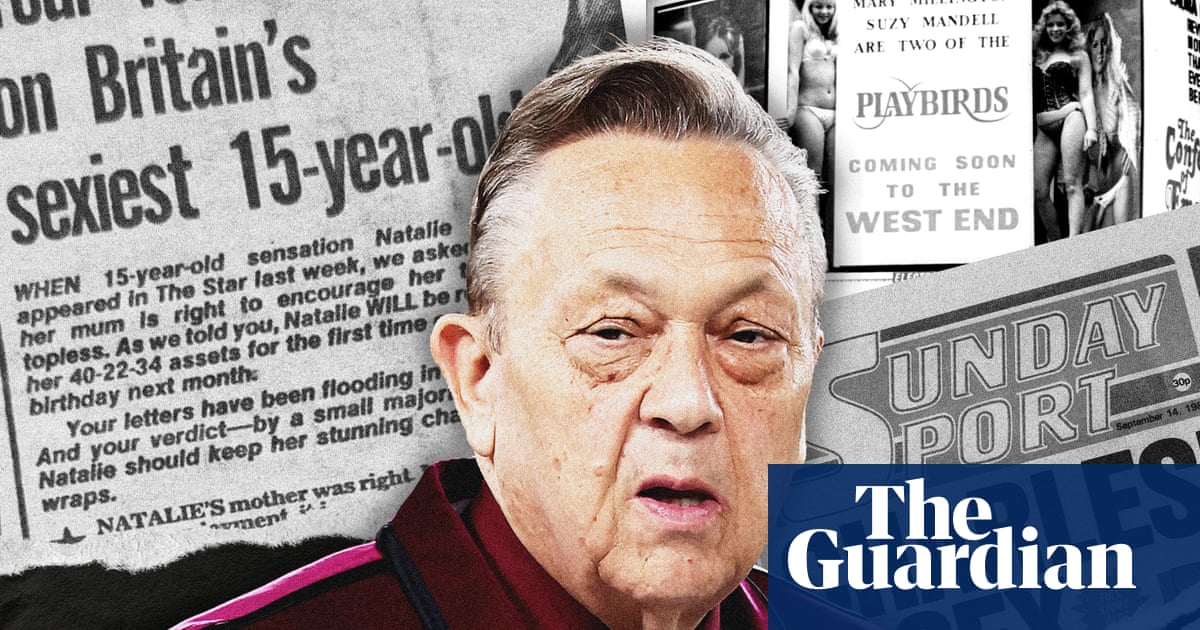
In 1987, the tabloid press in Britain was at the peak of its powers. The Sun newspaper, with its brash celebrity scoops and strident support for Margaret Thatcher – who won her third general election that year – was selling almost 4m copies a day.
Competition for stories and readers was relentless, resulting in ever more salacious and lurid editorial devices to win a slice of the readership from rivals on the newsstand. The Sun stood atop the tabloid market, its topless Page 3 girls credited with a share of its popularity. It was against this backdrop that the Sunday Sport, a red-top publication occupying the seediest corner of Fleet Street, launched a feature that even by its own standards appeared to plumb the depths of journalistic ethics.
On 6 September 1987, the newspaper began counting down to the 16th birthday of schoolgirl Natalie Banus – when she could legally be pictured topless.
Owned by the pornography baron David Sullivan, who announced his resignation as a joint-chair and director of West Ham this weekend, the Sunday Sport had launched in the previous year in a blaze of controversy.
Its coverage of Banus coincided with a short-lived and ill-fated merger with its ailing rival, the Daily Star – the Sunday Sport was briefly rebranded as the Star Sunday Sport – and together they devoted countless column inches to the teenager they described as “the sexiest 15-year-old in Britain”, measuring “a fantastic 40-22-34”.
When Banus, from Hendon, north London, first appeared in the Sunday Sport, the newspaper pushed the law to its limits by picturing her semi-naked, her chest obscured only by her arms. The law at the time forbid the publication of indecent images of under 16s. The Sunday Sport insisted it was compliant with the rules as Banus was “not quite topless”.
It described 15 as being “the age of the nymphet” and proclaimed Banus “the sexiest Lolita of them all”. Fully topless pictures of Banus, from Hendon, north London, were duly published in the Daily Star when she turned 16 a month later. The Sunday Sport also encouraged its readers to call a premium-rate chat line to have a chance of hearing her voice.
Almost 40 years on from her tabloid debut, Banus reflected on her glamour modelling career in a memoir, Dark Star, published earlier this year. “The Sunday Sport wished me a good [birthday] and told readers that I was legal, meaning that I could both show my boobs and that anyone who had sex with me no longer had to fear they might be arrested,” she said.
Banus, who had hoped to be a ballet dancer before being scouted by a glamour photographer, said she wept when she read the pieces published in anticipation of her birthday. One Daily Star piece included an account of an alleged incident in a changing room where she said she feared a teenage boy would sexually assault her. After she turned 16 on 11 October, she recalled that the Daily Star ran topless pictures of her “all week … always paired with some nonsense story about me being so proud of my tits, getting groped or fantasising about sex”.
This led to more work with Sullivan’s magazines and newspapers, with some of her explicit shoots taking place in his former home in Essex, she said. In her memoir, Banus said that Sullivan told her she was “a cut above so many models” and “dynamite” when it came to selling papers.
Despite her condemnation of the newspapers she featured in, Banus has always stopped short of criticising Sullivan personally and has never made any allegations about his behaviour towards her. In her book, she said: “While opinions on him may vary, I say with honesty that he has shown me courtesy and kindness in our dealings.” After the news of Sullivan’s departure from West Ham broke, Banus reiterated that he had “always treated [her] with respect and courtesy.”
Sullivan’s career in the adult entertainment industry has been thrown into sharp focus this weekend, after he announced he was standing down as a director and co-chair of West Ham to apply his “full energy and attention” to fighting what he described as “false allegations” concerning his personal conduct.
Seven women have accused Sullivan of sexual misconduct in a joint investigation by BBC Panorama and the Times. Three women alleged Sullivan abused his power as the owner of the Sport newspapers to prey on them for sex when they were seeking work.
A further four women accused Sullivan of exploitative and predatory behaviour, including allegations he tried to pressure them into sex during business meetings.
The BBC and Times said their reporters had spoken to dozens of former models and industry insiders, with some sources alleging Sullivan was known for so-called casting couch behaviour.
Sullivan has denied the allegations, which the BBC and Times said spanned decades, starting in the 1980s and involving women in their late teens and early 20s. Through his lawyers, Sullivan said: “I categorically deny all of these complaints.”
He added: “After a lifetime spent building businesses in the adult industry, in which I have met thousands of women, it is sadly inevitable that a small number of improper conduct claims are being made against me.” He did not respond to follow-up queries from the Guardian.

While the relationship between the Star and the Sport lasted just eight weeks – it was reported that advertisers and journalists began to vote with their feet, largely in protest at the seedy influence of Sullivan – he was undeterred. The Sunday Sport and its sister paper, the Daily Sport, continued for more than 15 years to celebrate the 16th birthdays of teenage girls by picturing them topless.
The images were often published alongside the newspapers’ famously outlandish stories. (They claimed a London bus had been found at the south pole, and that aliens had turned a man into a fish finger.) Some teenage models became staples of their pages for years to come, but others retreated from the limelight, bruised by the sudden exposure to the sleaziest end of Britain’s newspaper market. Some young women were encouraged to share details of their supposed sexual experiences, which several later alleged were exaggerated or simply made up.
On 3 July 1994, the Sunday Sport pictured a bikini-clad Linsey Dawn McKenzie, from Wallington, south London, beneath the headline: “Please print my boobs when I’m 16.” It told its readers that “stunning schoolgirl” McKenzie, who went on to be one of the country’s most high-profile glamour models, was 15 years, 10 months, three weeks and four days old – meaning there were just under six weeks to go until her milestone birthday. It said that for “legal reasons” it wouldn’t show her fully topless until she was 16.
McKenzie, who recently retired from glamour modelling after more than three decades, featured in the newspaper every week until she turned 16. As the weeks ticked past, it encouraged its readers to draw pictures of how they imagined McKenzie would look topless and printed its favourites. It dished out coupons so its clientele could pre-order copies of its 14 August edition, where it was promised McKenzie would reveal all.
“Here she is at last, folks,” the newspaper said, when the day finally arrived. “Lovely Linsey Dawn McKenzie – sweet sixteen and stripped bare for YOU.”
On 17 May 1998, it was Zoe Parker’s turn. Parker, who had been scouted just weeks earlier when her stepfather, Bob, took her to a pornography fair, appeared topless in the Sunday Sport next to the headline: “I’m sweet 16 and I can’t get enough.” The accompanying article was replete with details about her supposedly outrageous sex life. The ensuing furore saw Parker, living in Stamford, Lincolnshire, expelled from school.
The next year, Parker told the Sunday People that she had been coerced into glamour modelling by Bob and that it had driven her to the brink of suicide. “I was lonely, frightened and couldn’t carry on,” she said. “I couldn’t take any more and I thought the only way was to kill myself.”
Parker later claimed that some of the things she had said in the media about her sexual experiences were “rubbish” but alleged she was encouraged to invent stories by her stepfather who thought it “great publicity”. For his part, Bob said he had “only tried to encourage my daughter to do what she wanted to do”.
The Sport newspapers also profited from adverts for videos involving 16-year-old girls well into the 00s. In 2002, they ran a series of promotions for “incredibly hardcore” pornographic videos involving “barely legal” teenagers, some of whom they claimed were in school uniforms or had been filmed having sex for the first time.
One of the last 16-year-old models to grace its pages was Cherry Frampton, from Buckley, north Wales, who appeared under the name Cherry Dee. Scouted at 15, she first appeared topless in the Sunday Sport on 10 August 2003, next to the headline: “Happy 16th bare-day”. An advert in the Daily Sport the previous day, showing Frampton in lingerie and suspenders, said: “She’s sweet 16 and just left school, her boobs are 32E and still growing. Tomorrow, only in the Sunday Sport, she’s getting them out!”
At 20 years old, six months after being crowned Miss Sunday Sport 2007, Frampton gave up glamour modelling to train as a nurse. Speaking about the glamour industry more generally, she later told the Wales on Sunday newspaper that she was concerned about some models openly doing cocaine on shoots, adding that, for some of her peers it was a gateway to sex work. “Loads of them worked as strippers, in lapdancing clubs and as escorts, some of them even selling sex,” Frampton said. “I know a lot of them were tempted into porn but I wasn’t hungry for all that.”
A change in the law in 2004 – making it illegal to publish indecent images of under-18s – sounded the death knell for Sullivan’s countdown to 16. However, for several years, the internet has been awash with rumours about how he treated both the young models who were handpicked to adorn the Sport’s pages and other women and girls he came into contact with.
Sullivan is a man who has been making money from the sex industry for decades. Born in Cardiff in 1949, he moved to Hornchurch, Essex, at the age of 11. After graduating with a degree in economics from Queen Mary College, University of London, he began selling explicit photos via a small mail-order business he established in the east end of London in the early 1970s. A string of sex shops and pornographic magazines followed.
“I was incredibly lucky, because I was getting raided by Scotland Yard weekly, but we became very chummy with them,” Sullivan recalled in a Channel 4 documentary, broadcast in 2024. “The head of the obscene publications squad came to see me one day and said: ‘I’m going to help you. Now, as long as you avoid bondage, you won’t face prosecution.’ That allowed me to do things other magazines weren’t doing. We charged on, and destroyed the market.”
By 25, Sullivan was a millionaire, and decided to branch into films. The first, and most successful, was 1977’s Come Play With Me, starring Sullivan’s then girlfriend, Mary Millington. She took her own life in 1979, after a series of raids on a sex shop she operated in south London, saying she felt “beaten” by the police. She left a suicide note for Sullivan, asking him to push for more pornography to be legalised. Sullivan continued to distribute pornographic footage of her after her death, apparently in tribute to her.
Sullivan described Come Play With Me as “a Carry On film with tits and bums and pubic hair”.
“I had made a pile of money and I thought, I fancy making a movie for a bit of fun,” he told Channel 4. “Within a week, we were filming.”
Come Play With Me was marketed as the “strongest sex comedy film ever produced and distributed in Britain”. The press reported at the time that some actors went on strike because the final cut was far more explicit than they had anticipated.
As Sullivan’s notoriety grew, so did his apparent demands on the young women he encountered. Several have since spoken publicly about how he would expect sexual favours in exchange for work. Vicki Scott, a former glamour model and Marilyn Monroe lookalike, recalled her first encounter with Sullivan in the late 1970s, in an interview with the Sunday People.
“I’ll never forget when I was about 19 and I went to see him for the first time about a magazine job,” Scott said, speaking in 1987. “After telling me to strip off, he tried it on and I would not have it. He said: ‘That’s how it is if you want to work with me.’” Scott, then 29, told the newspaper that she had tried to warn other aspiring models about Sullivan. “I’d tell the girls: ‘Look, you can see Dave, but you’ll probably have to sleep with him,’” she said.
At the time, Sullivan did not address Scott’s comments directly but said he was declaring “war” on the Sunday People, and reportedly told its journalists:” “If your editor wants to delve into my private life, I will delve into his.”
In 1981, the News of the World was contacted by Sue Stewart, a 24-year-old secretary who said she had answered an advertisement for a £150-a-night job carrying out “promotional entertainment work”. In an interview with the newspaper, Stewart said Sullivan had asked her to undress, then tried to have sex with her. When she refused, he reportedly said: “If you aren’t going to do anything, it’s like a boxer without any training. I don’t know what you can do.”
The News of the World then asked an undercover reporter, Tina Dalgleish, to respond to a similar advert. When she arrived at Sullivan’s then home in Chigwell, Essex, she said he wanted to know whether she was “interested in doing anything sexually” for money.
According to Dalgleish, Sullivan said: “We’re not going to persuade you to do anything you don’t want to do. But do you want to get up to no good or not? I mean, my time is valuable.” She said he invited her to his bedroom, where he suggested they have sex so he could “judge her performance”. Dalgleish wrote that she made her excuses and left. Sullivan does not appear to have commented on the story at the time.
The next year, Sullivan was convicted of living off the immoral earnings of prostitutes after two London saunas he operated were raided by police. Mark Killick, a journalist who wrote a book about Sullivan published in 1994, said the women working there were “poorly paid and exploited”. Sullivan was ordered to serve nine months in prison, but was freed after 71 days when he successfully appealed against the length of his sentence.
After his release, Sullivan tried to distance himself from the more extreme fringes of the sex industry. He set his sights on two longstanding ambitions: owning a newspaper and a football club.
The Sunday Sport was launched in 1986, followed by the Daily Sport in 1991. As most businesses would not advertise in the newspapers, their pages were filled with promotions for premium sex chat lines, reportedly controlled by Sullivan and staffed by some of the models who featured in the newspapers.
Sullivan sold his stake in the Sport newspapers in 2007 in a deal that earned him about £40m, but bought back some shares in 2011 in an apparent effort to save them after the company entered administration.
His big move into football came when he took over Birmingham City in 1993 with his business partner David Gold, whose family ran the Ann Summers empire. To the astonishment of the footballing world, he appointed 23-year-old Karren Brady, an unknown Sport advertising executive, as its managing director, launching a career that would culminate in a peerage and a starring role alongside Alan Sugar in the long-running BBC series The Apprentice. She severed her decades-long business relationship with Sullivan in April, resigning as vice-chair of West Ham United.
This is not the first time there have been questions surrounding Sullivan’s behaviour. In July 2008, he was arrested on suspicion of sexually assaulting a 25-year-old actor who had visited his mansion in Theydon Bois, Essex. He denied the woman’s claims and, after an investigation lasting almost three months, the police decided to take no further action in light of advice from the Crown Prosecution Service.
In a later interview with the Birmingham Mail, Sullivan claimed the encounter was consensual. “Anybody can make an allegation against anybody in this country and the police have to investigate,” he said. “I’m a rich person, so I’m a target for this sort of thing. That is the world we live in.”
Sullivan and Gold sold Birmingham City shortly afterwards, buying West Ham United in early 2010. Sullivan’s former long-term partner, the one-time pornography actor and Sport glamour model Emma Benton-Hughes, with whom he has two adult sons, briefly served on the club’s board. Under his ownership, the club won its first trophy in 43 years, clinching the Uefa Conference League title with a 2-1 win over Fiorentina in 2023.
However, in recent years, fans have become increasingly dissatisfied with his stewardship of the club. Their anger reached boiling point last month when the team was relegated from the Premier League. The crowd was vocal in its condemnation when Sullivan attended last month’s game against Leeds United with his reality television star fiancee, Ampika Pickston. He plans to marry Pickston, who features in the ITV series The Real Housewives of Cheshire and is 32 years his junior, next year.
Over the coming days, the past exploits of a man who has made his vast personal wealth from the sexualised images of young women and girls, and pushing the law to its limits in order to publish the most extreme content possible, will probably face intense scrutiny.
His history has not precluded him from reaching the pinnacle of British sport, a position from which, for many years, he exercised control over not just a prominent football club, but its women’s team and academy system for children. Despite his resignation, he retains significant financial influence over the club as its largest shareholder. Whether that position will remain tenable now details of the new allegations he faces have emerged remains to be seen.
#Revealed #David #Sullivans #Sunday #Sport #sold #sexualised #images #15yearold #girls #Media