wellnessfitpro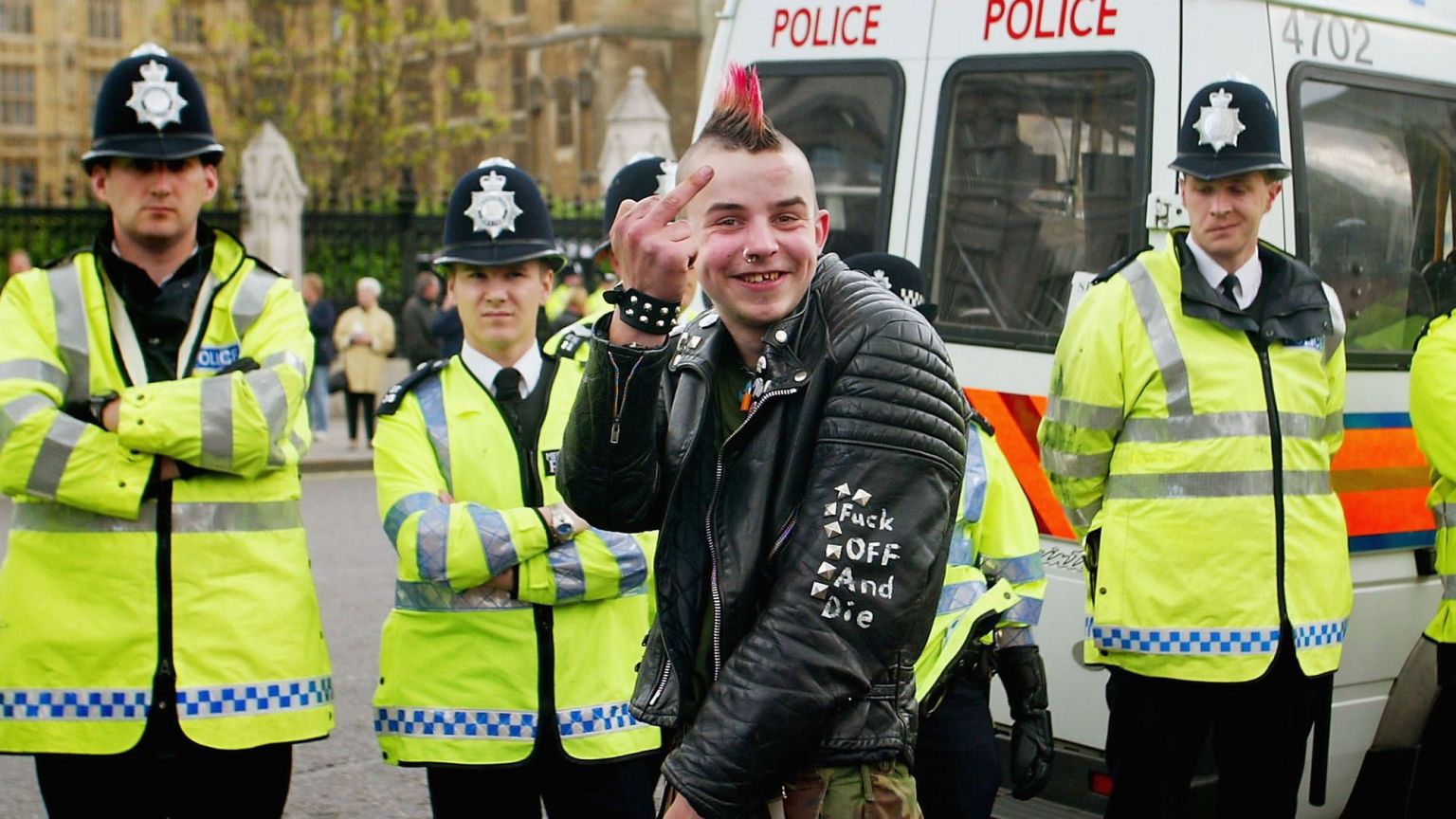
Punk’s appeal has long existed beyond music. It’s always been about the lifestyle and the mood that goes with it: it’s always been about deliberate transgression, about saying and doing whatever respectable society tells us is beyond the pale. It’s always been about rebellion.
However, rebellion will always be relative. Early punks were leftists, in the main, because the establishment was conservative. But if yesterday’s rebels are today’s cultural and political authorities, then you can’t be anti-establishment by being left wing. We see this taking place in much of contemporary Britain: the institutions responsible for defining respectable opinion have shifted substantially to the progressive side of things. Because of this, most of the language, the jokes, the political positions capable of causing genuine offence and alarm now come from the anti-progressive side.
For much of modern history (and certainly before and during the height of punk’s success), censorship was the preserve of the respectable conservative. The Hays Code governed Hollywood for decades. It restricted everything from profanity and sexual content to portrayals of crime and supposed immorality – so much so that Alfred Hitchcock was able to offend sensibilities simply by showing a flushing toilet in his 1960 film, Psycho. In Britain, meanwhile, we had Mary Whitehouse to contend with, who became a byword for the censorious conservative through her campaigns against sex, violence, bad language and the general degradation of public morals.
It has traditionally been up to the left, therefore, to house many of those looking for liberation, irreverence and free expression.
Punk took this instinct and pushed it arguably further than anyone ever had before in the 1970s. The Sex Pistols attacked the monarchy (alongside a dozen other national pieties), while The Clash tied punk more explicitly to left-wing and anti-authoritarian politics. There was rarely anything resembling a coherent manifesto coming out of punk – because that would sort of defeat the point, wouldn’t it? It was a movement there simply to say No and to win liberation in part through giving offence.
A lot of it was stupid, nihilistic, ugly, or worse. But again, that was the point. Its great cultural weapon (and the great cultural weapon it gifted us) was the willingness to be told, you can’t say that, and to say it anyway.
Punkish rebellion and the cultural left seemed natural allies for a generation or two. Then the roles were reversed somewhere along the way. The left is now no longer a counterculture. Universities, publishing, the arts, charities, entertainment and much of the media have taken on progressive presumptions as the only sacred cows worth bothering with. Vocabulary has changed accordingly: speech is no longer condemned as obscene, indecent or corrupting. Instead, it is harmful, problematic, unsafe or, of course, offensive. It is a politics of micro-aggressions and intersectionality, and of the removal of dissenting voices.
The power is softer – it is the power of ex-punks who have ditched the leathers and spikes in favour of Charles Tyrwhitt shirts and beige chinos. Respectable opinion is now hemmed in by institutional codes, professional consequences, cancellations and social opprobrium. Yet it’s difficult to miss the family resemblance to conservative censors of old: excuses for one adult to decide what another should be allowed to say, hear or do.
The only real difference is that those doing the censoring have crossed the aisle.
Hence, for better or worse, the rise of right-wing punk. John Lydon (better known as Johnny Rotten) has spent years gleefully offending progressive sensibilities and endorsing right-wing populists. Former Misfits singer Michale Graves, meanwhile, has a long history of right-wing political involvement, evolving through early noughties ‘conservative punk’ advocacy. He eventually went on to directly align himself with the far-right group the Proud Boys in 2020 and support the 6 January Capitol rioters.
And speaking of the Proud Boys… Gavin McInnes is himself perhaps the neatest embodiment of the punkish shift towards anti-progressive subcultures. He co-founded Vice in the Nineties, when it was a scrappy Montreal punk magazine built around offensiveness, bad taste and contempt for polite opinion. Fast forward 20 years and Vice’s oeuvre has become mainstream and McInnes has long since left them to found the Proud Boys, who carried much the same kind of instinct for provocation and taboo-breaking into far-right politics.
None of this means that being offensive makes you correct. There was plenty of stupidity coming out of punk when it was largely a creature of the left. There is plenty to lament in its more right-wing adherents today. Gavin McInnes is neither a virtuous nor an admirable man: I wouldn’t ever put him on a pedestal (I’m sure he wouldn’t want me to). But the inversion and sentiment behind it at least makes a great deal of sense.
It would be nice if modern left-wing punks stopped acting as though their opinions were so subversive, that they were such brave radicals for espousing them. They are not. Because countercultures form against whatever culture becomes powerful enough to defend their sacred cows. When yesterday’s rebels have the institutions, grants, HR departments, university faculties and cultural cachet, defending their orthodoxies is no longer rebellion. It is establishment behaviour.
With progressive politics representing respectable cultural opinion – and with it being as all-consuming, heavy handed and intolerant as it is – expressing populist or socially conservative views is far more likely to produce the shocked silence punk once craved. You need to be made of strong stuff to stick your head above the parapet these days – you need to be a rebellious soul willing for people to think badly of you.
Punk was never really about having the correct politics – or the correct anything, really. It was about refusing to behave as expected. We are now expected to behave within the progressives’ framework. And if that framework is now a respectable opinion, we should not be surprised when rebellious souls begin kicking against it. Because they, far more than your average blue-haired trans activist, are the true punks, and they will tell you to get fucked every time.
James Dixon is a Glasgow-based novelist, poet and playwright.
#death #leftwing #punk