wellnessfitpro
Introduction: UK house prices fall in August
Good morning, and welcome to our rolling coverage of business, the financial markets and the world economy.
UK house prices have fallen on an annual basis for the first time in almost three years, as the housing market is hit hit by rising borrowing costs and geopolitical uncertainty.
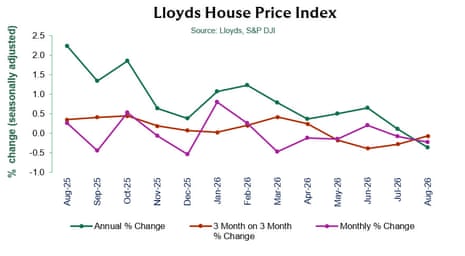
Lender Lloyds has reported this morning that house prices fell by 0.4% in August, compared with a year ago, which is the first year-on-year decrease since November 2023.
On a monthly basis, prices fell by 0.2% in August, following a 0.1% drop in July, meaning the average property now costs £298,468.
This is weaker than expected – economists had forecast a 0.1% monthly rise, and a 0.2% increase compared with a year ago.
Andrew Asaam, mortgages director at Lloyds, explains that the market remains subdued in August:
“The housing market has faced a more difficult backdrop in recent months, with the impact of global events on inflation and borrowing costs creating greater economic uncertainty.
What we’re not seeing is a rush of homeowners cutting prices. But more are choosing to sit tight, with sellers reluctant to accept offers they feel are too low, while some buyers are waiting to see how conditions develop.
As a result, fewer homes are changing hands, with latest industry figures showing mortgage approvals now at their lowest level since the start of 2024.
And there may be worse to come – as the recent bond market turmoil has pushed up lenders’ borrowing costs.
That increase in ‘swap rates’ could make mortgages more expensive, leaving buyers with less firepower in the market.
The agenda
-
7am BST: Lloyds house price index
-
7am BST: German industrial output data for July
-
Today: UK chancellor John Healey outlines his economic agenda
Key events
North-South house price divide continues
Lloyds also reports that prices fell more sharply in the South of England in August, but rose in the North, and in Wales, Scotland and Northern Ireland.
Prices fell in the South because of the “greater affordability challenge caused by higher average prices”, the bank reports.
According to Lloyds:
-
The South East saw the largest decline, with prices down -1.6% year-on-year to £381,729.
-
In Greater London, where prices fell -1.5% to £534,177.
-
The South West and Eastern England both recorded annual declines of -1.2%.
But, there was growth elsewhere….
-
Northern Ireland continues to record the strongest annual growth, with prices up +6.9% year-on-year.
-
Prices in Scotland rose by +3.5% over the past year.
-
In Wales, annual growth stands at +0.6%.
-
In the North East of England, prices rose by 2.7% on an annual basis.
-
In the North West, prices were 2% higher than a year ago.
This chart of average UK house prices underlines how the flat the market has been over the last year:
But prices still up in the long term, Lloyds says
Lloyds’s Andrew Asaam adds that it’s important to keep the recent drop in house prices in perspective, explaining:
Average house prices remain around 25% higher than they were at the end of 2019, despite the substantial increase to interest rates seen over recent years. The market’s adjustment to higher borrowing costs has been gradual, with wage growth helping to offset some of the pressure on affordability. The recent modest declines in prices are best viewed in that wider context.
“We expect the market to remain fairly subdued in the months ahead, but this will likely only have a limited impact on house prices. While affordability remains a challenge, wages continue to grow and employment has held up better than many anticipated. This will help to support demand from those who need or want to move.”
Introduction: UK house prices fall in August
Good morning, and welcome to our rolling coverage of business, the financial markets and the world economy.
UK house prices have fallen on an annual basis for the first time in almost three years, as the housing market is hit hit by rising borrowing costs and geopolitical uncertainty.
Lender Lloyds has reported this morning that house prices fell by 0.4% in August, compared with a year ago, which is the first year-on-year decrease since November 2023.
On a monthly basis, prices fell by 0.2% in August, following a 0.1% drop in July, meaning the average property now costs £298,468.
This is weaker than expected – economists had forecast a 0.1% monthly rise, and a 0.2% increase compared with a year ago.
Andrew Asaam, mortgages director at Lloyds, explains that the market remains subdued in August:
“The housing market has faced a more difficult backdrop in recent months, with the impact of global events on inflation and borrowing costs creating greater economic uncertainty.
What we’re not seeing is a rush of homeowners cutting prices. But more are choosing to sit tight, with sellers reluctant to accept offers they feel are too low, while some buyers are waiting to see how conditions develop.
As a result, fewer homes are changing hands, with latest industry figures showing mortgage approvals now at their lowest level since the start of 2024.
And there may be worse to come – as the recent bond market turmoil has pushed up lenders’ borrowing costs.
That increase in ‘swap rates’ could make mortgages more expensive, leaving buyers with less firepower in the market.
The agenda
-
7am BST: Lloyds house price index
-
7am BST: German industrial output data for July
-
Today: UK chancellor John Healey outlines his economic agenda
#annual #fall #house #prices #November #subdued #market #business #live #Business